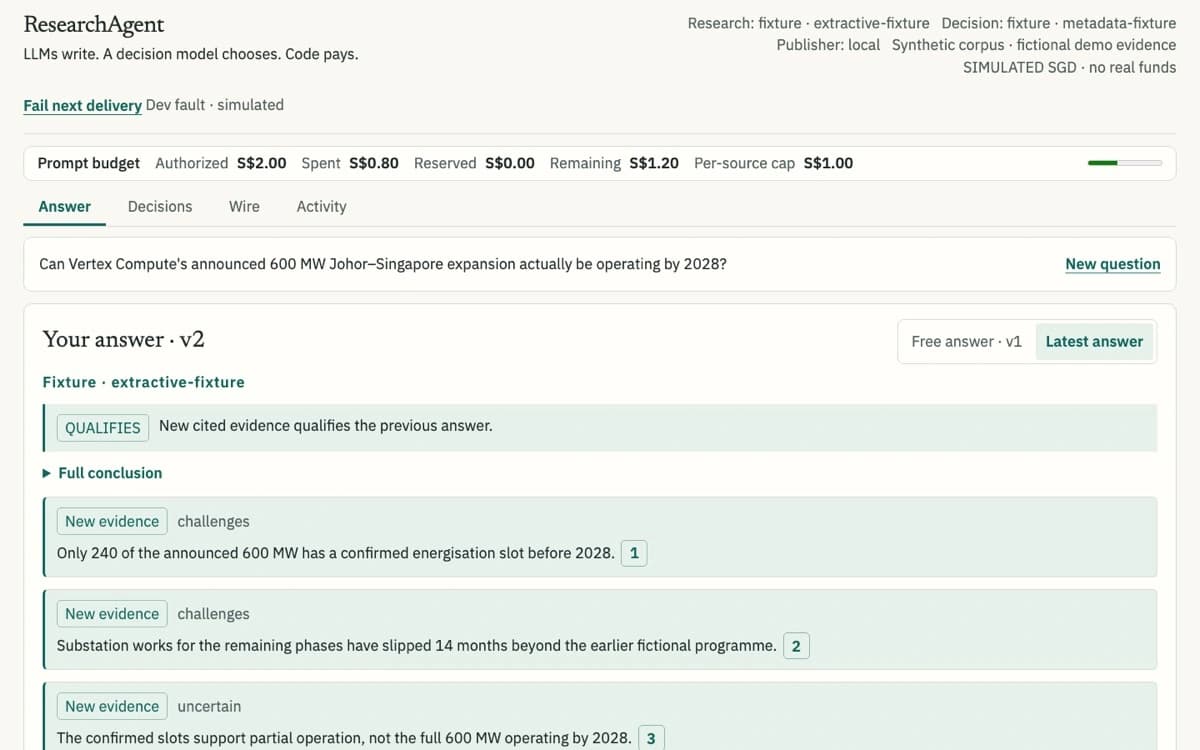
I worked with a team on ResearchAgent for SingHacks, where we became finalists. The question behind it was more specific than whether an agent could search the web: when should it pay for another piece of evidence, and what should happen if that evidence fails the promise behind the purchase? I later presented it on the main stage at AI Tinkerers Singapore on 10 October. The live demo placed among the top three Cloud Run demos at that meetup.
The demo uses fictional writers and articles. Payments run on XRPL Testnet, with a separately labelled simulated path for offline use. That keeps the experiment’s scope clear while letting us examine a real systems problem: a successful payment and a useful research result are separate events. A tool returning success cannot stand in for both.
Name the gap before buying the answer
ResearchAgent starts with open evidence. It groups what it has found into evidence families, identifies a gap, and considers whether a paid source could fill it. This gives the purchase a reason beyond finding another relevant-looking title. Repeated versions of the same underlying claim should not automatically count as new support. The useful question is what the next source adds to the answer.
The model’s assessment then meets deterministic policy. Budget and per-source limits constrain what it can spend; payment intent and recipient checks sit outside the model’s prose. I find that separation useful when reading the system: the agent can explain why it wants something, while the payment path still has explicit conditions to enforce. A persuasive explanation does not itself authorise a transfer.
Follow the failed purchase
- Keep purchase intent distinct from settlement, so retry handling does not casually create another charge.
- Verify the delivery against its signed manifest before treating the passage as evidence.
- Quarantine a failed proof and follow the challenge/refund path.
- Continue the research with another source, then assemble a cited answer from accepted evidence.
The retained walkthrough follows that less convenient route: a purchase, a failed proof, a challenge and refund, then another purchase. It makes the recovery behavior visible instead of cutting directly to a polished answer. Delivery verification still has a limited meaning. Matching a signed promise can establish what arrived; it does not establish that an article’s claims are true or that it answers the research question well.